IF.20200228.NWNLNew Work – New Language2020
A study turning the mouse cursor into a channel for non-verbal communication in remote work, with eight design principles and a handful of prototype tools.
A study into non-verbal communication in digital collaboration, focused on the mouse cursor as a channel for it. Master’s research with Philipp Czampiel in Strategic Innovation and Product Development at the Bergische Universität Wuppertal, 2020.
Interviews with people working on spatially separated creative teams were combined with a study of twelve participants working in Miro, the web whiteboard the team also used itself. Mouse movements were recorded, plotted as paths and heat maps, and checked for position, velocity and acceleration — including a task where participants searched for a hidden figure on a busy image, tracked mid-test.
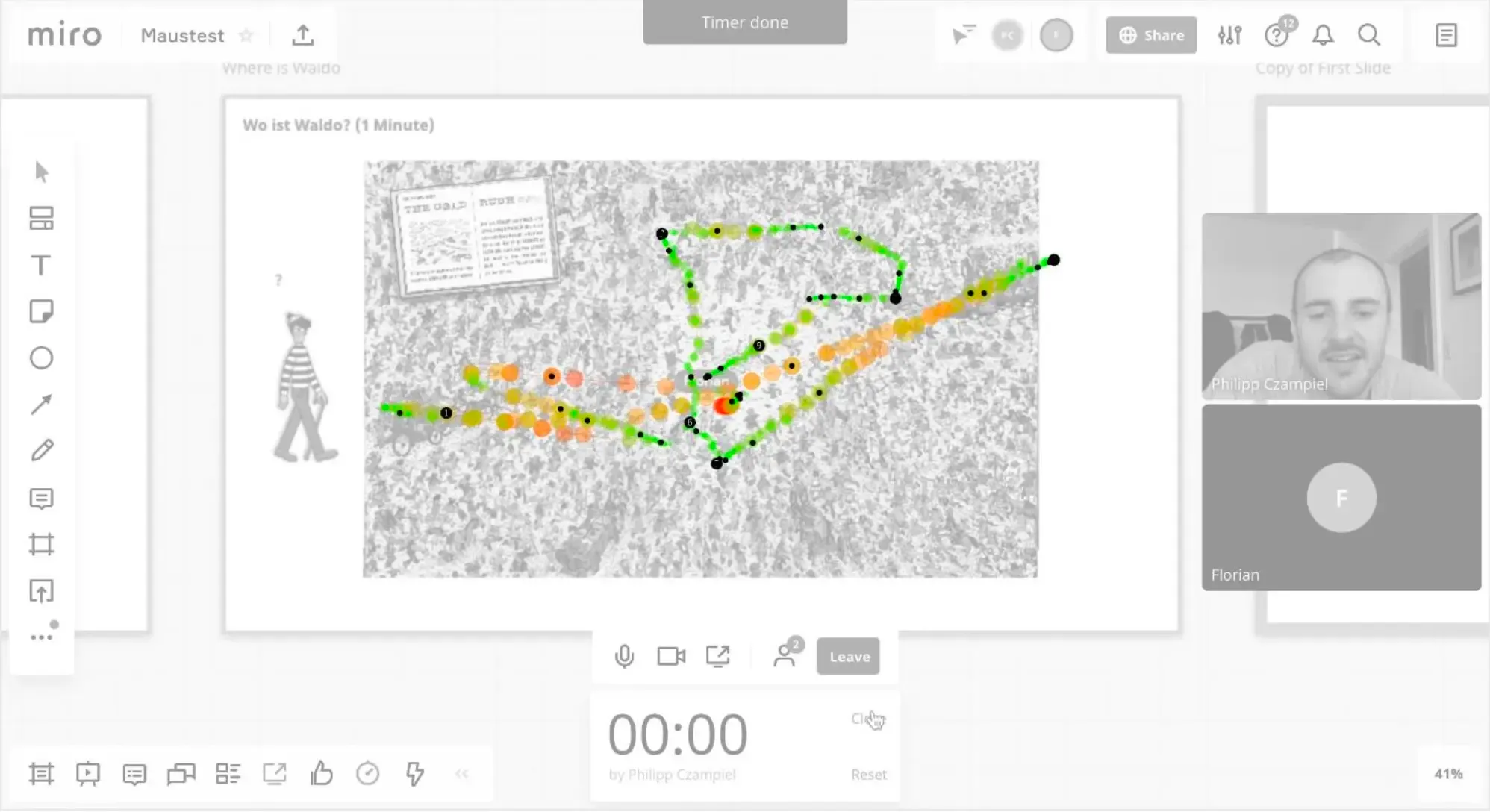
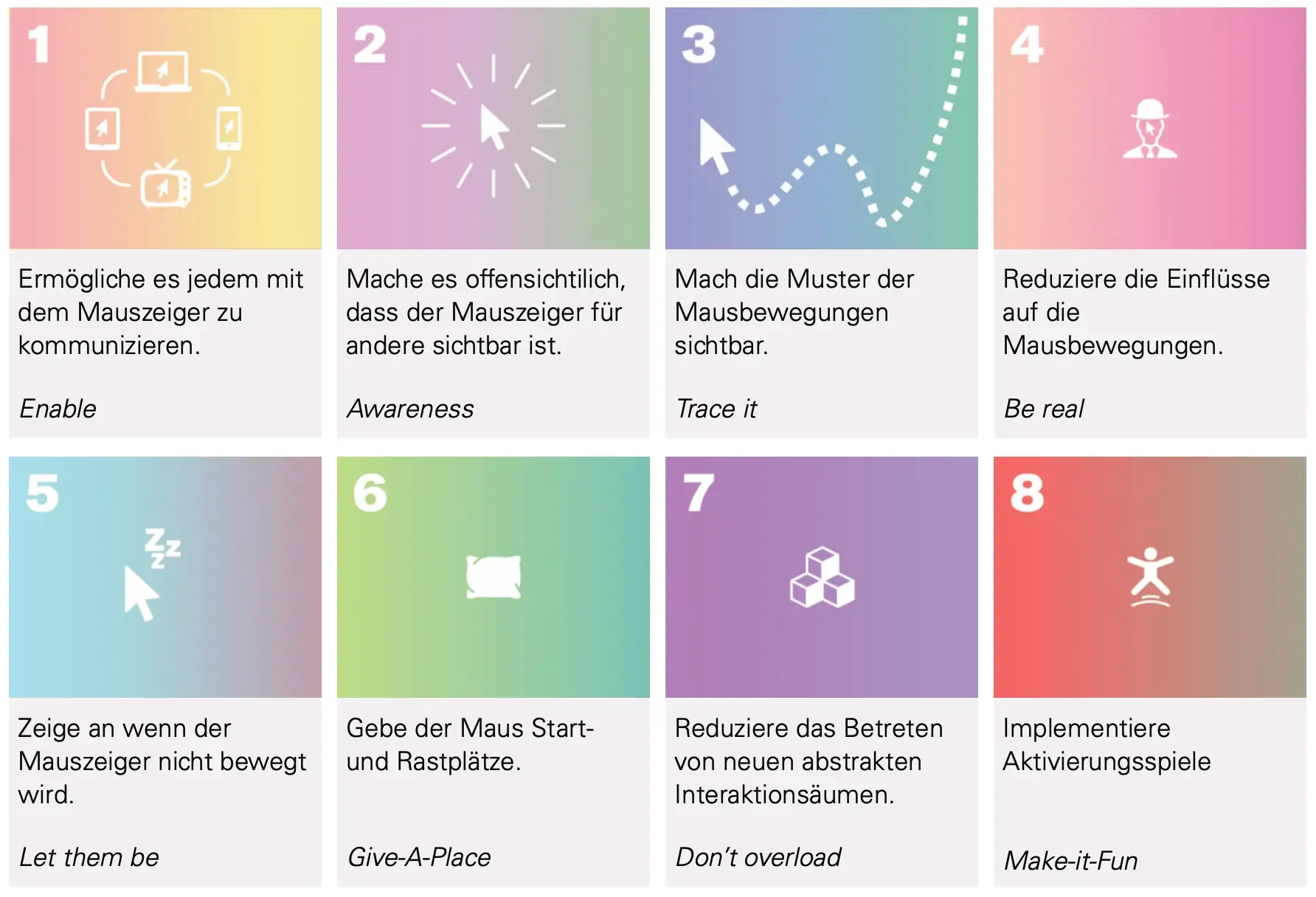
Clear, repeatable patterns turned up: people avoided covering their name tag or blocking others’ view with their pointer, movement got calmer once a board’s layout was familiar, and touchscreen input distorted the readings enough to be treated separately. From these, eight design principles were written down, from making the pointer visible to giving it a place to rest.
The principles were sketched into small tool concepts: a meeting-mood wheel, a presentation progress bar, a status check for joining a call late, and a handful of small games built to give the pointer something to do together, from a shared maze to a collaborative image search.
The harder decision was the scope itself: non-verbal communication online covers a lot of ground, and narrowing the whole field down to the mouse cursor alone was what made the rest of the work possible.
The study ran with twelve people from the team’s own design circle — enough to find patterns worth writing down, not enough to call them proven. A larger, more varied sample would be the next step.